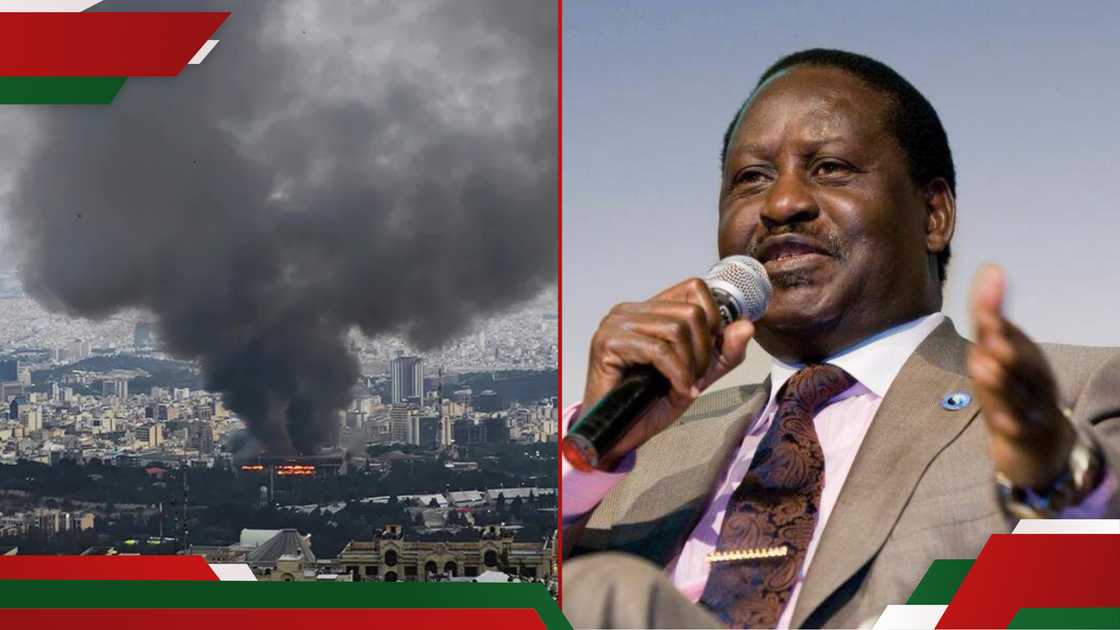
The lead story in the June 23, 2025, edition of
The
Standard
newspaper was a gross misrepresentation of facts, a calculated distortion of history in motion, and a flagrant act of political propaganda masquerading as journalism.
It claims that Raila Amolo Odinga, the indefatigable champion of democracy and social justice, betrayed the Gen Z-led anti-Finance Bill 2024 uprising. The paper could not be further from the truth.
Indeed, if there is any individual who has borne the
brunt
of resisting autocracy and economic oppression in Kenya, it is Raila Odinga.
He has spent decades in the trenches—detained without trial, tortured, vilified, exiled—so that
the people of
Kenya could enjoy the very liberties that
he is proud that
Gen Z is now exercising with admirable boldness.
To attempt to paint him as a betrayer of a movement rooted in justice, accountability, and economic freedom is both ahistorical and dishonest.
Let us set the record straight.
First, it must be acknowledged that the Gen Z
protests
did not emerge in a vacuum. It arose from a continuum of Kenyan struggles against neoliberal oppression,
punitive
state policies, and broken promises.
In June and July of 2023, long before many of today’s commentators even noticed the impact of state fiscal overreach, Raila Odinga led protests against the Finance Bill 2023.
That Bill aimed to raise taxes on ordinary Kenyans—on housing, digital services, fuel, and incomes—
ostensibly for accelerated
development, but in reality
to plug the holes left by
decades of
elite mismanagement and corruption.
Those protests saw the deaths of dozens of young Kenyans, many of whom were shot in cold blood while exercising their constitutional right to assemble
and picket
. Odinga did not abandon them.
He walked side by side with them at great personal risk in the process, surviving assassination attempts in broad daylight and full view of cameras.
He mourned with
Kenyans who had lost their dear ones
. He condemned the killings.
He called for justice. He stood with them—while those now crying betrayal were either complicit in silence or distracted by political expediency.
Fast forward to May 2024. Once again, Odinga led Azimio la Umoja One Kenya Coalition in convening to analyse the newly proposed Finance Bill 2024—this time even more draconian than its predecessor.
The coalition invited tax experts, economists, civil society actors, and members of Parliament to the Sarova Stanley Hotel. The result was a comprehensive analysis of how the Bill would escalate economic suffering and choke the country’s productive sectors.
Slides from that Azimio PG presentation were disseminated widely online. These became key tools in the digital mobilisation led by Gen Z activists—tools that clarified, educated, and armed citizens with evidence.
Gen Z did not spring from nowhere; it took up a baton passed on by the broader Kenyan movement, including Odinga’s own efforts. To claim betrayal, therefore, is to deny this intergenerational continuity and mutual reinforcement. It is a politically expedient rewriting of the facts.
Unlike some establishment figures who met the Gen Z protests with disdain, Raila Odinga lauded the youth. He did not attempt to hijack their struggle.
He did not seek to impose an Azimio stamp on it. Instead, he respected its organic nature and celebrated its unprecedented success. On June 2
5
, 2024, when protesters overran Parliament and the Judiciary
and also
forc
ed
a dissolution of the cabinet, it was not lost on him or any serious political analyst that Kenya had entered uncharted territory.
The youth had achieved in weeks what conventional political movements had failed to do in years.
At that point, the conversation shifted. From opposing a singular Finance Bill, the protests now called for the resignation of President Ruto. “Ruto Must Go” was not a policy demand.
It was a political ultimatum. With the three arms of government discredited and overrun
, Kenya stood at the
horns of a political dilemma
.
Faced with this reality, any responsible leader must assess possible outcomes. As a party, Azimio outlined five possible scenarios:
Scenario one, r
esignation of President Ruto and succession by the Deputy—a constitutional option.
Was this the alternative the protestors were suing for?
Second scenario, a m
ilitary intervention—akin to developments in Sudan, Egypt, or Tunisia
after the Arab Spring “revolutions
.
”
Scenario three, a
palace coup, which history shows can usher in prolonged instability.
Scenario four, o
utright anarchy—with balkanized militia rule, civil strife, and state collapse.
And finally, scenario five. The exercise of p
opular sovereignty through Article 1 of the Constitution—a national dialogue and citizen-led resolution.
Given the foregoing,
Odinga championed the fifth option. He called for a national conversation, not to dilute the Gen Z momentum, but to anchor it in constitutional legitimacy
and not let their gallant efforts go to waste
. He did not betray the movement. He sought to safeguard it from being hijacked by chaos and reactionary forces.
Odinga’s decision to take the high road, to insist on dialogue and national coherence,
cannot be termed a
betrayal,
as
The Standard’s
propaganda seeks to plant in the psyche of its readership
. It is leadership.
True, the call for a national dialogue was rejected in the heat of protest. That is the nature of an uprising—radical, emotional, and unstructured. But it is the duty of elder statesmen to offer structure and a path forward, not to cheer as the country teeters over the edge.
To argue, as The Standard does, that Odinga capitulated or colluded is to ignore history and distort facts. By July 2024, street demonstrations had already subsided. The momentum had shifted from mass action to elite reaction.
Those who now claim that Odinga betrayed Gen Z are either willfully blind or politically dishonest. They ignore that it was Odinga, more than
m
any other leader
s
, who pushed for
the enactment of the new Constitution
that enshrined Article 1—the sovereignty of the people.
They forget that it was Odinga who warned about the dangers of violent state responses
to peaceful protests
, about the
rampant abductions
, and about the fragility of our hard-won democratic gains.
It would be remiss not to interrogate
The Standard
itself. The newspaper’s recent editorial line raises questions about its motivations. Owned and managed by figures tied to past regimes and elite economic interests,
The Standard
has a documented history of silence during state-sponsored violence, assassinations, and repression.
From the Moi era
detentions without trial, official torture at Nyayo House and assassinations
to the
recent
interregnum,
this media house
has often aligned itself with
status quo
forces.
The Monday lead story
reeks of the same betrayal it seeks to project. It betrays
honest
journalism. It betrays objectivity. It betrays the Kenyan people’s desire for truthful, constructive engagement.
This is not the first time this media house has attempted to discredit
Raila
Odinga. From the 1980s when it ridiculed detainees, to the 2000s when it whitewashed stolen elections,
The Standard
has too often stood on the wrong side of history.
Let us be clear. Kenya is in the midst of a profound transformation. Gen Z has done the country proud. They have reclaimed civic agency and shaken the foundations of impunity. But their struggle is not detached from the broader freedom movement. It is part of the same arc of justice that leaders like Raila Odinga have pursued for decades.
To attempt to split that arc, to pit the present against the past, is to aid the oppressors. It is to do the
devil’
s work for it. We must reject false dichotomies and manufactured betrayals. The real betrayal would be to let the movement descend into anarchy. The real betrayal would be to let state violence return unchecked.
The real betrayal would be to abandon the dream of a united, just and democratic Kenya.
And that’s what the Memorandum of Understanding signed on March 7, 2025 to guard against.
Raila Odinga did not betray the people. He has always stood with the people. He stands with them still.
Let
The Standard
look for traitors elsewhere.