China’s Trade with Pakistan Soars to $23 Billion in Latest Figures

Pakistan, June 25 — As of June 23, a total of 163 trade agreements have been signed at the 9th China-South Asia Expo, with a combined contract value of 8.663 billion yuan.

According to the Yunnan Provincial Department of Commerce, 150 of these are formal agreements worth 8.3 billion yuan, 12 are letters of intent totaling 213 million yuan, and one is a framework procurement agreement valued at 150 million yuan.

Professor Lin Minwang, Vice Dean of the Institute of International Studies at Fudan University, shared his views in an interview with China Economic Net:

“China and South Asian countries share a common vision for the future and the world. We all hope for a stable international order and resilient supply chains. Right now, both sides are working toward deeper interconnection.

In today’s turbulent global landscape, our shared interests are growing. China is strong in industrialization, while many South Asian countries excel in agriculture.

This complementarity creates significant potential for future economic cooperation.”

Xu Bu, member of the UN Secretary-General’s High-Level Advisory Board on Effective Multilateralism and President of the Institute of Global Development and Security at Jiangsu University, provided further insight in an exclusive interview with China Economic Net:

“When we talk about multilateralism today, it’s unfortunate that the global system is not functioning as effectively as it should.

However, multilateral cooperation in the Asia-Pacific region is advancing rapidly. China’s partnerships with both South and Southeast Asian nations are strengthening regional multilateral frameworks that benefit all parties involved.

The China-South Asia Expo is a crucial platform that supports this progress. It has facilitated significant economic cooperation-not just between China and South Asia, but also with Southeast Asia.

For instance, China’s bilateral trade with Pakistan has exceeded $23 billion, and with India, over $150 billion. Regional economic cooperation is on a constructive path, but we must not take it for granted.

Continuous efforts are needed to safeguard and sustain cooperation-whether in economics, security, or politics.”

Amid a global realignment of trade, regional cooperation is emerging as a key strategy for navigating uncertainty and promoting shared prosperity.

In this context, China’s deepening ties with South and Southeast Asian countries have gained remarkable traction.

Events like the China-South Asia Expo are playing an active role in integrating regional supply chains and enhancing market connectivity.

Zhou Mi, a researcher at the Chinese Academy of International Trade and Economic Cooperation, emphasized Asia’s unique strengths: a combined consumer market of 2.8 billion people, representing immense potential, and strong institutional frameworks like the Regional Comprehensive Economic Partnership (RCEP).

“These factors,” he noted, “create ideal conditions for building a more cohesive regional economic community.” He added:”In my view, regional collaboration presents a powerful package for long-term development.

If we look back at North America-take NAFTA, for example, established in 1994-it was built on the developmental differences between the U.S., Canada, and Mexico, which helped foster vertical integration along the supply chain.

Similarly, China, Southeast Asia, and South Asia, with their vast populations and diverse development stages, offer immense opportunities.

The RCEP negotiations began in November 2012, led by ASEAN and initially involving its six existing FTA partners (China, Japan, South Korea, Australia, New Zealand, and India). We hope to strengthen these types of mechanism further, ensuring collaboration is grounded in mutual commitments.

These commitments can shape expectations and lay the foundation for a new, globally significant platform for cooperation and development.”

Raila Odinga Urges Leaders to Take Sides: “Now Is Not the Time for Neutrality” in Iran-Israel Conflict


  • Raila Odinga called on world leaders to break their silence and take a stand on the escalating conflict between Israel and Iran, warning of a looming global war

  • The ODM leader made the remarks while addressing residents of Jomvu in Mombasa county, where he criticised what he termed as silence in the face of grave injustice

  • He condemned Israeli attacks on Palestinians and recent strikes on Iran, urging the international community to push for a lasting solution through the creation of a sovereign Palestinian state


News.co.ke journalist Harry Ivan Mboto has over three years of experience reporting on politics and current affairs in Kenya

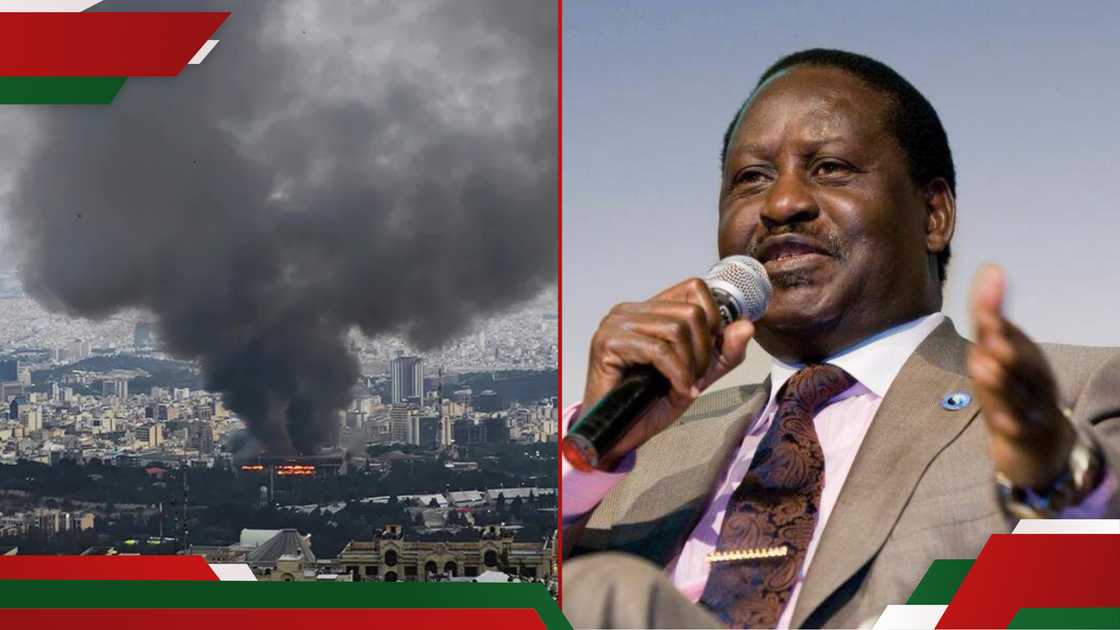
As tensions in the Middle East continued to rise, ODM leader Raila Odinga broke his silence and urged others to do the same, warning that humanity was staring at the real possibility of a third world war.

Speaking in Jomvu, Mombasa county, on Tuesday, June 24, Raila addressed the ongoing hostilities between Iran and Israel, which have recently drawn in the United States.

He urged global leaders to speak up and take clear positions, saying the world could not afford to remain neutral in such a critical moment.

“The world is burning. Bombs are being dropped. Iran and Israel are at war, and America has also joined. Yet leaders are shying away from speaking about it. This is a very important matter,” he stated.

What did Raila say about Israel, Iran war?

Raila expressed concern over what he described as acts of aggression by Israel, particularly in Gaza.

He said civilians, including women and children, had for years suffered bombardment, which he labelled crimes against humanity. According to him, recent events in the region had only worsened the situation.

“You have seen what is happening in Gaza. For a long time, women and children have been bombed and killed by Israel. Even now, many Palestinians are being killed. That is an act that must be condemned,” he said.

He added that Israel had carried out an unprovoked attack on Iran earlier in the day, followed by retaliatory strikes involving the United States.

He criticised these actions, saying they undermined peace and could ignite wider conflict.

“The US has also followed and bombed Iran. That is not right. We are telling the warmongers to stop, so that there can be peace,” Raila said.

To prevent further bloodshed, the veteran politician called for a long-term political solution to the Palestinian question.

He advocated for the establishment of a unified and free Palestinian state, arguing that this was the only sustainable path to lasting peace in the region.

Raila made it clear that his sentiments reflected both his personal beliefs and the position of the ODM party.

Did Trump broker peace between Israel and Iran?

In a related development reported by

News.co.ke

, US President Donald Trump announced that a ceasefire had been reached between Israel and Iran after nearly two weeks of escalating conflict.

His declaration came just hours after Iran launched missiles at a US military base in Qatar, a move that followed American strikes on Iran’s nuclear facilities. Trump claimed the truce was secured with Qatar’s help and described it as a diplomatic win.

The situation, however, remained tense. Iran’s leadership pushed back against claims of an official agreement, saying attacks would only stop if Israel ceased its military operations.

After US Strikes Iran, North Korea Watches Closely


Pyongyang has shared weapons technology and underground construction know-how with Tehran. Now it will want to know how it can best protect itself should the US turn its military attention to North Korea.

North Korea on Monday condemned the
US attacks
against three of Iran’s key nuclear sites, accusing Washington of violating Iran’s territorial integrity and the United Nations Charter.

“The just international community should raise the voice of unanimous censure and rejection against the US and Israel’s confrontational acts,” North Korea’s Foreign Ministry said, according to the Yonhap news agency.

Pyongyang had previously described Israeli missile attacks against Iran as a “hideous act.”

North Korea-Iran alliance

Nuclear-armed North Korea has maintained friendly ties with Iran.

For decades, Tehran and Pyongyang have been suspected of military cooperation, including in developing ballistic missiles that Irainian scientists have reportedly since enhanced.

Around 20 years ago, North Korea began dispatching engineers with specialist deep tunneling expertise.

Since the three-year
Korean War began in 1950
, North Korea has concealed much of its own key military capabilities in underground bases.

The regime will be keen to determine the effectiveness of its underground bunkers, while looking at the impact of the GBU-57 “massive ordnance penetrator” weapons dropped by the US on Iranian targets in

Operation Midnight Hammer

.

“They are definitely watching very closely what is going on in Iran,” said Chun In-bum, a retired lieutenant general in the Republic of Korea Army and now a senior fellow with the National Institute for Deterrence Studies.

“I believe the conclusions that North Korea will come to will be that they need to
accelerate their nuclear weapons capabilities
, that they need to further fortify their storage areas,” he told News.

Chun added that the North Koreans need to adopt additional protective measures, such as enhanced air defense and retaliatory options.

Pyongyang unlikely to talk

Asked whether there is any likelihood of the attacks encouraging Pyongyang to return to dialogue, Chun said, “Absolutely not. It is just not in their nature.”

Nevertheless, North Korea was almost certainly as shocked as much of the rest of the world at the “decisive nature” of President Donald Trump’s administration, he said.

“This is an America that we have not seen for a long time and would have caught the North by surprise,” Chun said.

“The priority there now will be to ensure that the same thing does not happen to them, which is why I am sure they will be observing closely and accelerating their weapons programs.”

Pyongyang will be aware that its situation is starkly different from that of Tehran, however, both in terms of the geography of the country, the proximity of allies, and the status of the two nations’ nuclear programs, said Leif-Eric Easley, a professor of international studies at Ewha Womans University in Seoul.

“Pyongyang’s nuclear program is much more advanced, with weapons possibly ready to launch on multiple delivery systems, including ICBMs,” he said. “The Kim [Jong Un] regime can threaten the US homeland, and Seoul is within range of many North Korean weapons of various types.”

“In Iran’s case, Israel aggressively exploited Tehran’s strategic and tactical errors, using superior intelligence, technology, and training to degrade Iran’s air defenses, high-value personnel, and retaliatory capabilities,” he pointed out.

“North Korea will learn from Iran’s mistakes, South Korea is more risk-averse than Israel, and China and Russia are better positioned to help Pyongyang than Tehran.”

North Korean leader Kim Jong Un will also lean on his alliance with Russian President Vladimir Putin, he said, to obtain the latest weapons and technology and in sufficient amounts to preserve his regime.

Moscow hosts Iranian minister

“It is no coincidence that Moscow was quick to host Iran’s foreign minister after the US strikes, and that Putin sent Sergei Shoigu to meet Kim Jong Un while the G7 was gathering in Canada,” he said.

“Russia’s coordination with Iran and North Korea shows how security across multiple regions is increasingly linked.”

Ultimately, however, Kim’s priority is ensuring his own personal safety and the future of the only hereditary communist dictatorship, said Chun.

And he will have been deeply alarmed at Trump’s hints that the US military knew where
Iranian supreme leader Ayatollah Ali Khamenei
was hiding and that he favors regime change in Tehran.

“Even now, Kim is very well protected from the threat of a ‘decapitation strike,’ with veils of secrecy around his location and movements,” Chun said.

“I am sure he will maintain that secrecy and make sure that the information on his whereabouts at any time is as limited as possible.”


Edited by: Keith Walker

Author: Julian Ryall